Google Hotel Booking Your Ultimate Guide
Google Hotel Booking simplifies your travel planning. This guide dives into its features, from searching and filtering to booking and integration with other Google services. We’ll explore the user experience, compare it to other booking platforms, and even look at Google Hotel Ads. Get ready to become a Google Hotel Booking pro!
We’ll cover everything from understanding the search filters and pricing displays to navigating the booking process and leveraging Google’s other tools to enhance your trip planning. We’ll also compare Google Hotels to competitors and discuss the impact of Google Hotel Ads on hotel visibility.
Google Hotel Search Functionality

Source: luxuo.com
Google Hotels aims to simplify the hotel booking process by providing a comprehensive search engine integrated directly into Google Search and Google Maps. Its functionality goes beyond a simple list of hotels; it offers powerful tools to filter and refine your search for the perfect accommodation.
Google Hotels utilizes a robust algorithm to aggregate pricing and availability data from numerous booking sites and directly from hotels themselves. This allows users to compare prices across different platforms without needing to visit each individually. The system also incorporates user reviews and ratings from various sources to provide a holistic view of each hotel.
Available Search Filters
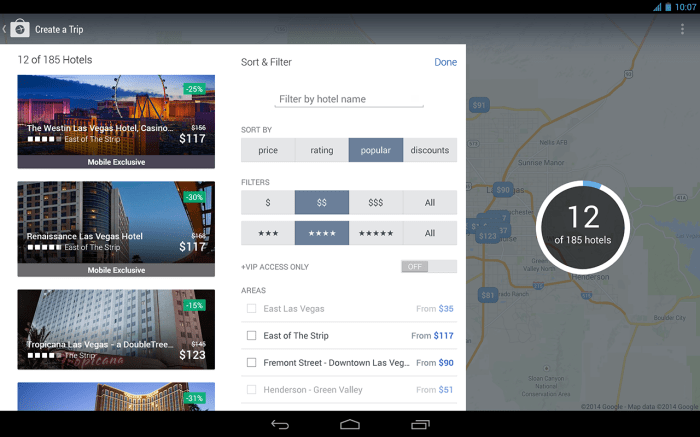
Google Hotels offers a wide range of filters to help users narrow their search. These filters cater to various preferences and needs, making it easier to find the ideal hotel. The filters are generally intuitive and easy to use, often presented as checkboxes or sliding scales.
- Dates: Users can specify their check-in and check-out dates, which is fundamental to any hotel search.
- Location: Search by city, neighborhood, or specific address, allowing for precise location targeting.
- Price: A sliding scale allows users to set a minimum and maximum price range for their search.
- Guest Rating: Filters based on user star ratings, allowing users to focus on highly-rated hotels.
- Amenities: Users can filter for specific amenities such as free Wi-Fi, parking, pools, or pet-friendliness.
- Hotel Class: Filter by hotel star rating (e.g., 3-star, 4-star, 5-star).
- Hotel Type: Options to filter by hotel type (e.g., Boutique, Resort, Business Hotel).
Pricing and Availability Display
Google Hotels displays pricing information clearly, usually showing the total price per night, including taxes and fees. Availability is indicated by a calendar view or simply by stating whether rooms are available on the selected dates. Price fluctuations based on demand are often reflected in real-time. The system aims to present a transparent and comprehensive pricing model, although it’s crucial to always double-check the final price on the booking site before confirming.
User Interface Comparison
Compared to other major hotel booking platforms like Booking.com, Expedia, or Kayak, Google Hotels generally offers a cleaner and more streamlined interface. While other platforms often have a more extensive feature set, Google Hotels prioritizes simplicity and ease of use. The minimalist design may be considered less overwhelming for some users, while others may prefer the more detailed information provided by competing platforms. The key difference lies in the focus: Google prioritizes search and price comparison, while others often emphasize detailed hotel descriptions and user reviews.
Hypothetical Interface Improvement
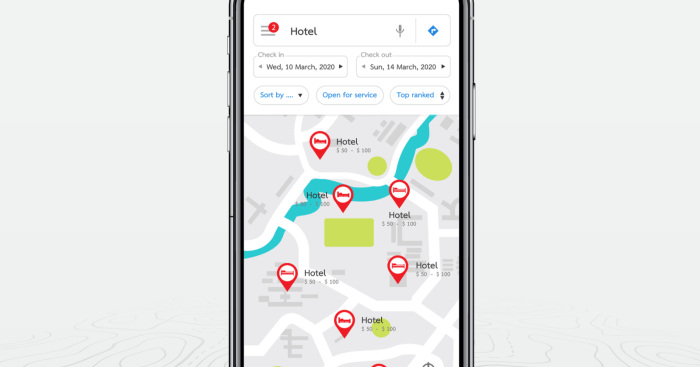
A potential improvement would be a more visually engaging map interface that integrates real-time pricing and availability directly onto the map. This would allow users to visually compare hotels in their desired area based on price and rating, enhancing the search experience and providing a more intuitive understanding of relative location and cost. For example, hotels could be represented by colored pins, with color intensity corresponding to price or rating.
Pros and Cons of Using Google Hotels
The following list Artikels the advantages and disadvantages of utilizing Google Hotels for your hotel booking needs.
- Pros: Comprehensive search, price comparison across multiple platforms, simple and intuitive interface, integration with Google Maps and Search.
- Cons: May not always offer the widest selection of hotels compared to dedicated booking sites, limited customer support compared to dedicated booking platforms, reliance on third-party booking sites for actual booking process.
Hotel Listings and Information Presentation
Source: googleapis.com
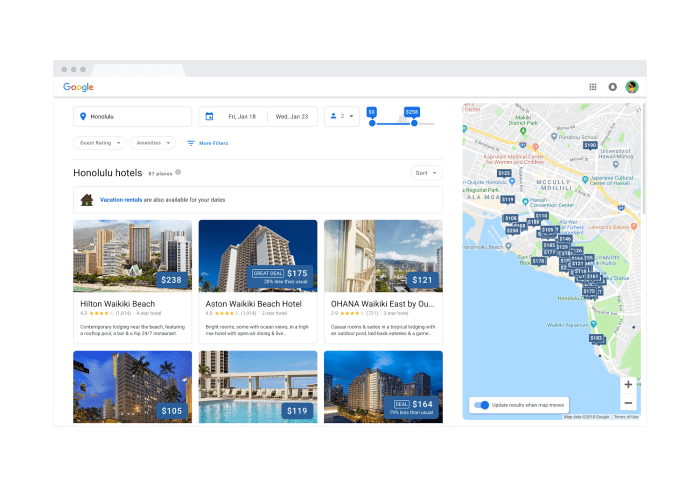
Google Hotels aims to provide users with a comprehensive and easy-to-understand overview of available hotels, enabling them to make informed decisions. This involves a clear presentation of hotel descriptions, amenities, visuals, and user reviews, all working together to create a compelling picture of each property.
Google Hotels presents hotel descriptions concisely, highlighting key features and selling points. For example, a description might begin with a brief overview of the hotel’s style and location, followed by a mention of popular amenities like free Wi-Fi or a swimming pool. It often includes details about the types of rooms available and any unique selling propositions, such as proximity to specific attractions or a focus on eco-friendly practices. The descriptions are generally factual and avoid overly promotional language.
Hotel Amenities Presentation
Hotel amenities are typically listed in a clear and organized format, often using icons or bullet points for easy scanning. For instance, a list might include items like “Free Wi-Fi,” “Fitness Center,” “On-site Restaurant,” “Parking,” and “Swimming Pool.” The presence or absence of specific amenities plays a significant role in user decision-making, so Google ensures this information is readily accessible. The level of detail provided varies depending on the hotel and the information provided by the hotel itself.
Image and Virtual Tour Usage
Google Hotels utilizes high-quality images to showcase hotels’ interiors and exteriors. These images often depict key areas like the lobby, rooms, restaurants, and pools. The images are carefully selected to present the hotel in a positive light, highlighting its best features. Many listings also incorporate virtual tours, allowing users to explore the hotel digitally before booking. These 360° views provide a more immersive experience, giving potential guests a much better sense of the hotel’s ambiance and layout. Imagine being able to virtually walk through the hotel lobby, view a guest room, and even explore the outdoor pool area – all from the comfort of your home.
Role of User Reviews and Ratings
User reviews and ratings are a crucial component of Google Hotels. These provide valuable insights from past guests, covering aspects like cleanliness, comfort, service, and value for money. Google prominently displays the overall star rating, along with a summary of the most common themes emerging from the reviews. Users can also filter reviews by aspects like “Cleanliness,” “Service,” or “Value,” allowing them to focus on areas of particular importance to them. This user-generated content significantly influences booking decisions, providing a level of social proof and transparency that enhances trust.
Comparison of Budget and Luxury Hotel Information
| Hotel Feature | Budget Hotel | Luxury Hotel | Difference |
|---|---|---|---|
| Room Amenities | Basic amenities (bed, bathroom, Wi-Fi) | High-end amenities (plush bedding, large bathrooms, premium toiletries, smart TVs) | Significant difference in quality and quantity of amenities. |
| Hotel Facilities | Limited facilities (possibly a pool or fitness center) | Extensive facilities (multiple restaurants, spa, concierge service, multiple pools, fitness center with advanced equipment) | Luxury hotels offer a much wider range of facilities and services. |
| Pricing | Lower nightly rates | Higher nightly rates | Substantial price difference reflecting the difference in amenities and services. |
| Images/Virtual Tours | Fewer images, often less professional photography | Many high-quality images, often including professional photography and virtual tours | Luxury hotels invest more in high-quality visual representation. |
| Reviews | Reviews may focus more on value and basic needs | Reviews may focus more on luxury experiences and exceptional service | Focus of reviews reflects the different expectations associated with each type of hotel. |
Impact of Google’s Partnerships on Information Accuracy
Google’s partnerships with hotels play a significant role in ensuring the accuracy and completeness of the information presented. Direct partnerships allow Google to access hotel data directly, reducing the reliance on third-party sources which may be outdated or inaccurate. This direct access ensures that information such as amenities, pricing, and availability is consistently updated. However, the accuracy still relies on the hotels providing correct and up-to-date information. Google employs various mechanisms to verify information and flag inconsistencies, but ultimately the responsibility for accurate data rests with the hotel partners.
Booking Process and User Experience: Google Hotel Booking
Source: fastly.net
Booking a hotel through Google Hotels is generally a straightforward process, aiming for speed and simplicity. However, the experience can vary depending on the hotel’s integration with Google’s system and the specific details of your search. Understanding the steps and potential pitfalls can help you navigate the process efficiently and avoid frustrations.
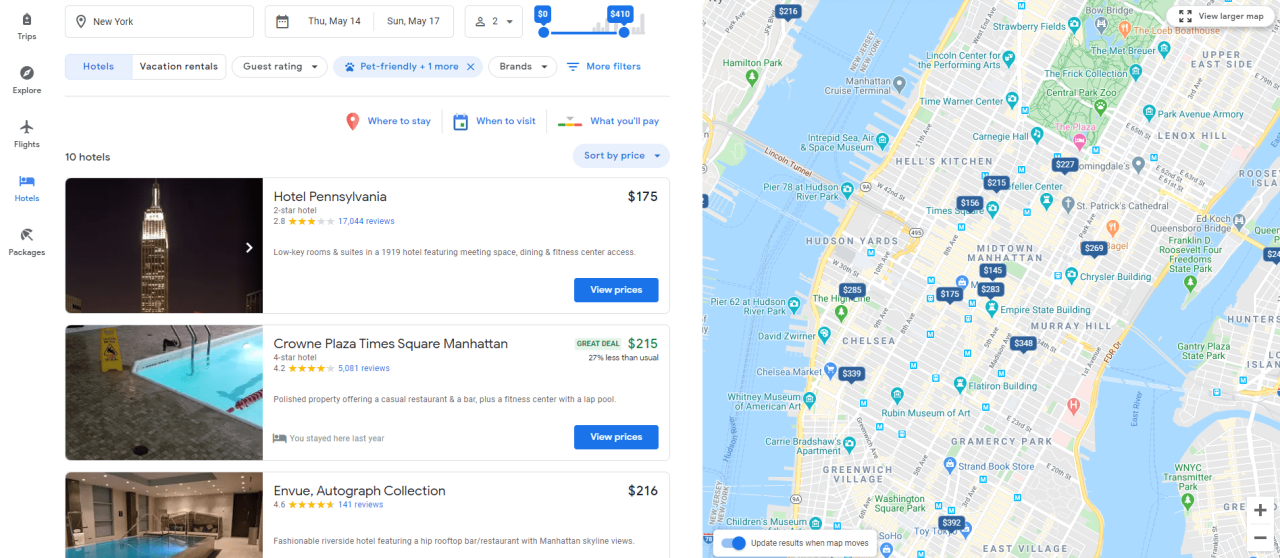
The core booking flow involves searching for hotels based on location and dates, browsing results with price and amenity comparisons, selecting a hotel and room type, reviewing the details, and finally completing the booking. Google aims to present all the necessary information upfront to minimize surprises and extra steps.
Steps Involved in Booking a Hotel Through Google Hotels
The process typically unfolds in these stages: Search, Selection, Review, and Confirmation. Each stage offers opportunities for customization and refinement of your hotel selection. Understanding these stages allows for a smoother booking experience.
- Search: Enter your destination, dates, and number of guests. You can also filter by price, amenities (e.g., free Wi-Fi, pool), star rating, and other preferences. Google’s algorithm will then display relevant hotel listings.
- Selection: Browse the hotel listings, comparing prices, photos, and amenities. Click on a hotel to view more details, including guest reviews and room types.
- Review: Once you’ve chosen a hotel and room type, review the booking details carefully, including the total price, cancellation policy, and any additional fees.
- Confirmation: After confirming the details, you’ll be redirected to a secure payment page to complete the booking. Upon successful payment, you’ll receive a confirmation email with your booking details.
Potential Pain Points and Areas for Improvement
While Google Hotels strives for a seamless experience, certain aspects could be improved. Understanding these areas helps manage expectations and potentially identify areas where Google can refine its service.
- Inconsistent Hotel Information: Sometimes, the information displayed on Google Hotels might not perfectly match the hotel’s website, leading to confusion or discrepancies. This could involve inaccuracies in amenities, cancellation policies, or even pricing.
- Limited Customer Service: Since Google acts as an intermediary, resolving issues directly with the hotel might require contacting Google support or the hotel separately, potentially adding complexity to the process.
- Hidden Fees: While Google aims for transparency, additional fees (resort fees, parking, etc.) might not always be clearly visible upfront, leading to unexpected costs at checkout.
Comparison to Booking Directly Through a Hotel’s Website
Booking directly through a hotel’s website versus Google Hotels presents different advantages and disadvantages. A direct booking often offers loyalty program benefits and potentially better customer service, while Google Hotels provides a convenient comparison platform.
| Feature | Google Hotels | Hotel Website |
|---|---|---|
| Price Comparison | Easy to compare multiple hotels | Only shows the hotel’s price |
| Loyalty Programs | Usually doesn’t offer hotel-specific loyalty points | Offers loyalty points and benefits |
| Customer Service | May require contacting Google or the hotel separately | Direct contact with hotel staff |
| Booking Process | Streamlined and quick | Can vary depending on the hotel’s website |
Google’s Payment Processing and Security, Google hotel booking
Google utilizes secure payment gateways to process transactions. The specific payment processors may vary but generally adhere to industry best practices for data encryption and security. Google’s reputation for security is a key factor in user trust.
Google employs robust security measures to protect user data during the payment process. This typically includes encryption protocols and adherence to PCI DSS standards.
Step-by-Step Guide: Booking a Hotel with Specific Amenities
Let’s say you need a hotel in New York City with a pool and free Wi-Fi for a weekend in October. This example illustrates how to leverage Google Hotel’s filtering options to find the perfect accommodation.
- Go to Google Hotels: Open your browser and go to Google Hotels or search for “hotels in New York City” on Google.
- Enter Dates and Guests: Input your desired travel dates (e.g., October 27-29) and the number of guests.
- Filter by Amenities: Use the filters to select “Pool” and “Free Wi-Fi”.
- Review Results: Browse the filtered results, checking prices, photos, and guest reviews.
- Select Hotel and Room: Choose your preferred hotel and room type.
- Review Booking Details: Carefully check the total price, cancellation policy, and any additional fees.
- Complete Booking: Enter your payment information and complete the booking process.
- Confirmation: You will receive a confirmation email with your booking details.
Integration with Other Google Services
Source: cloudfront.net
Google Hotels doesn’t exist in isolation; it’s deeply integrated with other Google services, creating a seamless and personalized travel experience. This integration leverages the vast amount of data Google collects to provide users with highly relevant information and streamline the booking process.
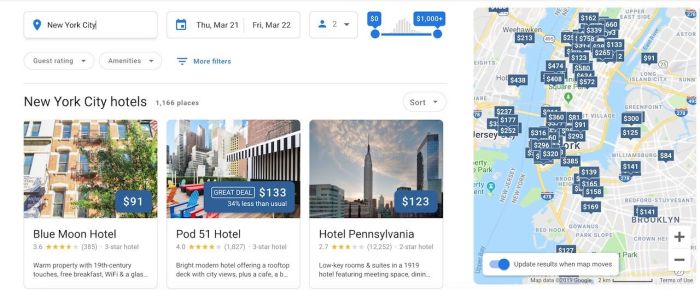
Google Hotels seamlessly integrates with Google Maps, allowing users to visually explore destinations, locate hotels on a map, and check their proximity to points of interest. This visual integration enhances the decision-making process, providing a much richer understanding of a hotel’s location and surroundings than a simple address could offer. This integration also allows for easy access to directions to and from the hotel once a booking is made.
Google Maps Integration Benefits and Drawbacks
The integration with Google Maps offers several significant benefits. Users can easily see a hotel’s location relative to other attractions, restaurants, and transportation options. This visual context makes it easier to choose a hotel that fits their travel plans. However, a potential drawback is that the reliance on Google Maps might inadvertently bias users towards hotels prominently featured on the map, potentially overlooking hidden gems further away from major landmarks. Over-reliance on visual cues might also lead users to overlook other important hotel attributes like pricing or guest reviews.
Personalized Hotel Recommendations Based on User Data
Google utilizes user data from various services, such as Google Search, Gmail, and Google Maps, to personalize hotel recommendations. For example, if a user frequently searches for eco-friendly accommodations or consistently books luxury hotels, Google Hotels will prioritize these types of hotels in its search results. Similarly, if a user’s Google Calendar shows frequent business trips to a specific city, Google Hotels might suggest business-friendly hotels in that location. This personalized approach aims to reduce search time and present the most relevant options to the user. However, this personalization relies on the accuracy and comprehensiveness of the user data Google collects, and potential biases in the data could lead to skewed recommendations.
Google Travel Planning Tools and Google Hotels
Google’s travel planning tools, accessible through Google Flights and Google Trips (now integrated into Google Travel), work in conjunction with Google Hotels to offer a comprehensive travel planning experience. Users can plan their flights and accommodation simultaneously, ensuring a cohesive travel itinerary. Google Flights provides flight information and pricing, while Google Hotels handles the accommodation booking. Once a flight and hotel are booked, Google Travel can integrate these bookings into a single itinerary, offering a centralized view of the trip’s details, including flight times, hotel check-in information, and potential points of interest near the hotel.
User Flow Diagram: Planning a Trip Using Multiple Google Services
Imagine a user, Sarah, planning a weekend trip to Paris. The user flow could look like this:
1. Google Flights: Sarah uses Google Flights to search for flights to Paris, specifying her desired dates and budget. She selects a suitable flight and proceeds to booking.
2. Google Maps: After booking the flight, Sarah uses Google Maps to explore Paris, identifying key attractions and neighborhoods she wants to visit.
3. Google Hotels: Based on her location preferences identified in Google Maps, Sarah uses Google Hotels to search for hotels in those areas. She filters her search based on price, amenities, and guest reviews.
4. Google Hotels Booking: Sarah selects a hotel and completes the booking process through Google Hotels.
5. Google Travel: All her travel details (flight and hotel) are automatically aggregated in Google Travel, providing a single itinerary for her trip. Google Travel might also suggest nearby attractions and restaurants based on her hotel location and interests gleaned from previous searches.
Competitive Landscape and Market Positioning
Source: co.nz
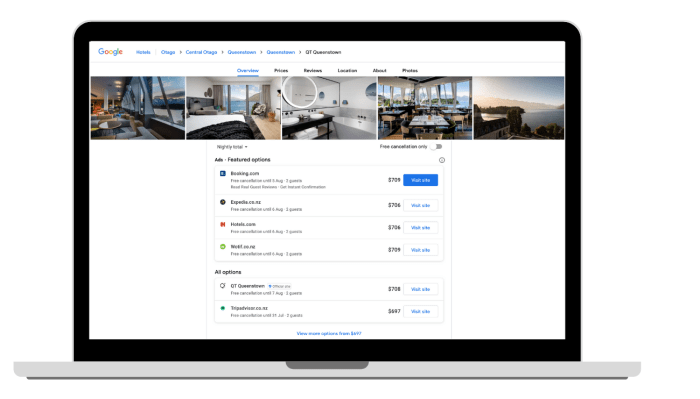
Google Hotels operates in a fiercely competitive online travel agency (OTA) market dominated by established players like Expedia and Booking.com. Understanding its position within this landscape is crucial to assessing its success and future prospects. This section analyzes Google Hotels’ competitive advantages and disadvantages, its user acquisition strategies, and its overall impact on the hotel industry.
Comparison with Expedia and Booking.com
Google Hotels distinguishes itself through its seamless integration with Google Search and other Google services. Unlike Expedia and Booking.com, which primarily rely on their own websites and apps, Google Hotels leverages the immense reach of Google Search, allowing users to easily discover and book hotels directly within their search results. This inherent advantage provides significant visibility and convenience. Expedia and Booking.com, however, often offer a wider selection of hotels, particularly smaller, independent properties, and sometimes feature more comprehensive hotel information and user reviews. They also frequently offer bundled deals, including flights and car rentals, which Google Hotels currently lacks to the same extent.
Google Hotels’ Strengths and Weaknesses
Google Hotels possesses several key strengths. Its integration with Google Search provides unparalleled reach and visibility. The simplicity and ease of use of its booking process also contribute to a positive user experience. However, its relatively limited hotel inventory compared to established OTAs like Expedia and Booking.com remains a weakness. Additionally, a lack of extensive customer service options and potentially fewer bundled travel packages represent areas for improvement.
Google’s Strategy for Attracting and Retaining Users
Google’s strategy centers around leveraging its existing user base and providing a superior user experience. By seamlessly integrating hotel booking into Google Search and Maps, Google capitalizes on existing user traffic. The convenience and speed of the booking process are key to attracting and retaining users. Google’s reputation for reliability and trust also plays a significant role in building user confidence. Furthermore, potential future developments such as enhanced personalization and loyalty programs could further strengthen user engagement.
Impact of Google Hotels on the Hotel Industry
Google Hotels has significantly impacted the hotel industry by providing hotels with another distribution channel. This increased competition can lead to lower prices for consumers and increased pressure on hotels to optimize their online presence. Hotels now need to manage their online reputation and pricing strategies across multiple platforms, including Google Hotels, to remain competitive. The shift towards direct bookings facilitated by Google Hotels can also influence the commission fees paid to OTAs.
SWOT Analysis of Google Hotels
| Strength | Weakness | Opportunity | Threat |
|---|---|---|---|
| Seamless integration with Google Search and Maps | Limited hotel inventory compared to competitors | Expansion into new markets and travel packages | Increased competition from established OTAs |
| User-friendly booking process | Limited customer service options | Development of loyalty programs and personalized recommendations | Economic downturns affecting travel spending |
| High brand trust and recognition | Lack of extensive travel deals and packages | Integration with more Google services (e.g., Google Flights) | Emergence of new travel booking technologies |
Impact of Google Hotel Ads
Source: searchenginejournal.com
Google Hotel Ads represent a significant opportunity for hotels to increase their visibility and attract more bookings. They leverage Google’s vast search network to connect potential guests directly with hotels offering the best rates and amenities. This system significantly impacts a hotel’s online presence and booking conversion rates.
Google Hotel Ads function by displaying hotel listings directly within Google Search results, Google Maps, and other Google services. When a user searches for hotels, Hotel Ads appear prominently, often above organic search results, showcasing hotel images, prices, and key amenities. This high visibility significantly increases the chances of a hotel being seen and selected by potential guests. The impact on visibility is particularly noticeable for hotels that might otherwise struggle to rank highly in organic search results.
Google Hotel Ads Pricing Model and Effective Campaign Strategies
Google Hotel Ads utilize a cost-per-click (CPC) model. Hotels only pay when a user clicks on their listing and is directed to their booking page. This makes it a performance-based advertising solution, where spending is directly tied to results. Effective campaign strategies involve careful targeting, competitive bidding, and utilizing high-quality images and compelling descriptions to maximize click-through rates. A key aspect is understanding the optimal bid strategy; this can range from automated bidding (letting Google’s algorithms manage bids) to manual bidding (requiring more hands-on management and optimization). A/B testing different ad creatives and targeting parameters is crucial for refining campaign performance and maximizing return on investment (ROI).
Comparison of Google Hotel Ads with Other Online Hotel Advertising
Compared to other online hotel advertising methods like metasearch engines (e.g., Kayak, Expedia) or social media advertising, Google Hotel Ads offer a unique advantage: direct integration with Google’s search ecosystem. While metasearch engines also drive bookings, they often involve commission fees and less direct control over the presentation of hotel information. Social media advertising, while effective for brand building, may have lower conversion rates for direct bookings compared to the immediate booking functionality offered by Hotel Ads. Google Hotel Ads thus provide a more direct path to bookings with a clearer understanding of cost per acquisition.
Optimizing Google Hotel Ads Campaigns
Optimizing Google Hotel Ads campaigns involves a multifaceted approach. Regularly monitoring campaign performance and adjusting bids based on real-time data is crucial. Analyzing which s are driving the most conversions and refining targeting based on these insights is essential. A/B testing different ad creatives, including high-quality images and concise descriptions highlighting unique selling propositions (USPs), can significantly improve click-through rates. Ensuring consistent rate parity across all booking channels is also vital to avoid frustrating potential customers and damaging brand reputation. Finally, utilizing Google’s various reporting tools allows for in-depth analysis of campaign performance, identifying areas for improvement and maximizing ROI.
Example of a Successful Google Hotel Ads Campaign
A boutique hotel in a popular tourist destination implemented a Google Hotel Ads campaign focusing on highly specific s related to its unique features, such as “luxury beachfront hotel [city name]” and “romantic getaway [city name]”. They used high-quality professional photography showcasing the hotel’s amenities and ambiance. Their bidding strategy involved a combination of automated and manual bidding, allowing for flexibility and precision. They consistently monitored campaign performance, adjusting bids and targeting as needed based on real-time data. This targeted approach, coupled with high-quality visuals and compelling ad copy, resulted in a significant increase in direct bookings and a positive return on investment. Their success hinged on the careful targeting of specific demographics and interests, ensuring their ads reached the most relevant potential guests.
Last Word
Source: amazonaws.com
Mastering Google Hotel Booking unlocks a world of convenient travel planning. By understanding its features, comparing it to other options, and utilizing its integrations, you can efficiently find and book the perfect hotel. Remember to explore the advanced search options and consider using Google Hotel Ads for optimal results. Happy travels!