Go Hilton Booking Site A User Experience Deep Dive
Go Hilton booking site: Navigating the Hilton website for hotel reservations is a common experience for many travelers. This exploration delves into the user experience, features, mobile responsiveness, content, and accessibility of the Hilton booking platform. We’ll examine its strengths and weaknesses, comparing it to competitors and offering suggestions for improvement. We’ll cover everything from the initial search to the final booking confirmation, exploring how Hilton’s site caters to different user needs and devices.
Our analysis will encompass various aspects, including the site’s design, functionality, and overall user-friendliness. We will look at how effectively the site communicates its value proposition, handles special requests, and adapts to various screen sizes. We’ll also assess its accessibility features and adherence to accessibility guidelines. Ultimately, we aim to provide a comprehensive overview of the Hilton booking experience and identify areas for potential enhancement.
Hilton Booking Site User Experience: Go Hilton Booking Site
Source: templatemag.com
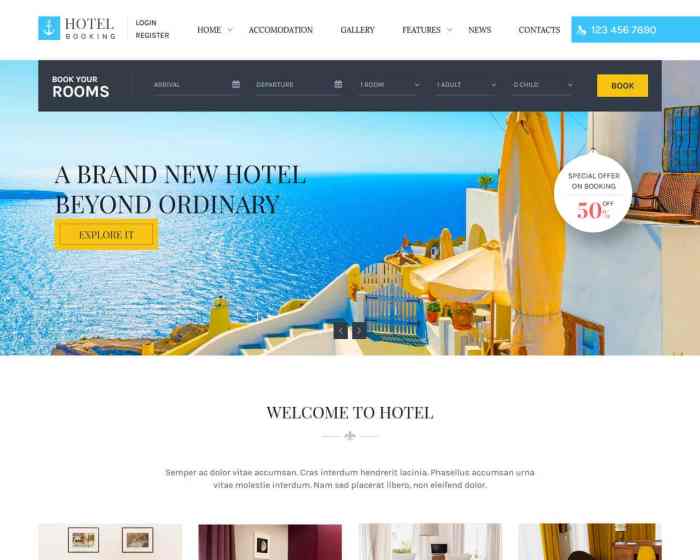
This section analyzes the user experience of the Hilton booking website, focusing on its design, navigation, search functionality, and areas for improvement. We’ll compare it to a competitor and suggest actionable improvements to enhance the overall booking process.
User Journey Map: Hilton Booking Process
A typical user journey on the Hilton website might look like this: The user begins by entering their desired destination and travel dates. They are then presented with a list of available hotels, which can be filtered by price, amenities, and other criteria. Once a hotel is selected, the user views room options and prices. After choosing a room, they proceed to enter guest information and payment details before confirming the booking. Throughout this process, the user interacts with various elements, including search bars, filters, calendars, and forms. Potential pain points could include difficulty filtering results, unclear pricing information, or a complicated checkout process.
Hilton vs. Marriott: UI Comparison
Both Hilton and Marriott websites aim for a clean, modern aesthetic. However, Marriott often presents a more visually appealing and intuitive interface. For example, Marriott’s use of high-quality photography and video showcases hotels more effectively. Hilton’s design, while functional, can feel somewhat less engaging. In terms of navigation, Marriott sometimes offers a more streamlined process, especially regarding filtering and sorting search results. Hilton’s use of drop-down menus can sometimes feel less intuitive than Marriott’s use of interactive elements. Both sites utilize similar booking flow structures, but Marriott often employs more visually engaging progress indicators.
Website Navigation and Search Functionality
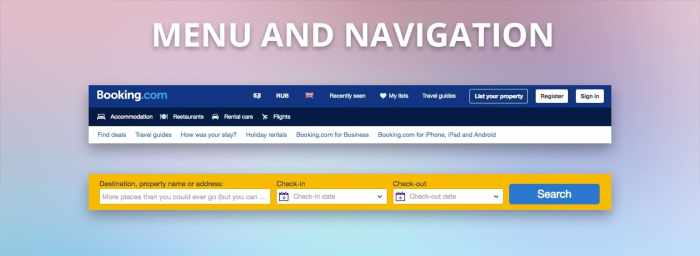
The Hilton website’s search functionality is generally effective. Users can easily search by location, dates, and guest count. However, the filtering options could be improved. For instance, while amenities are filterable, the specific amenities listed aren’t always comprehensive or easily understandable. Navigation is largely intuitive, using a clear menu structure. However, finding specific information, such as cancellation policies or loyalty program details, can sometimes require more clicks than ideal. For example, accessing detailed information about Hilton Honors points redemption often requires navigating through multiple pages.
Usability Improvements for the Hilton Booking Site
The following table Artikels specific areas for improvement on the Hilton booking website:
| Feature | Current State | Improvement Suggestion | Expected Outcome |
|---|---|---|---|
| Search Filters | Basic filters available, but limited detail and clarity. | Implement more granular filters, with clear descriptions and visual representations (e.g., icons for amenities). | Improved search precision and reduced time spent finding suitable hotels. |
| Pricing Transparency | Total price including taxes and fees isn’t always immediately clear. | Display the total price upfront, clearly breaking down all costs. | Increased user trust and reduced booking abandonment due to unexpected costs. |
| Checkout Process | Multiple steps and forms can be cumbersome. | Streamline the checkout process, minimizing the number of steps and using a progress indicator. | Faster and more efficient booking completion. |
| Mobile Responsiveness | Generally responsive, but some elements could be optimized for smaller screens. | Conduct thorough mobile testing and adjust layout/elements for optimal usability on various devices. | Improved user experience across all devices. |
Hilton Booking Site Features and Functionality

Source: joshuaostewart.com
The Hilton booking site offers a range of features designed to streamline the booking process and enhance the overall user experience. Its effectiveness hinges on a balance of intuitive design, comprehensive information, and robust functionality. This section details key features and how they contribute to a successful booking.
Special Request Handling
The Hilton website allows guests to specify various special requests during the booking process. For accessibility needs, users can typically select options relating to wheelchair accessibility, hearing assistance, or visual impairments. The system often prompts for detailed specifications in a text box, allowing for personalized requests. Similarly, requests for early check-in or late check-out are often accommodated through an online request form linked directly to the reservation. While not guaranteed, these requests are generally considered and processed by the hotel upon confirmation. For example, a guest needing a roll-in shower can select that option during the room selection, and the system will only display rooms that meet that criterion.
Booking Confirmation and Post-Booking Communication
Upon completing a booking, the Hilton site provides an immediate confirmation page displaying the reservation details, including dates, room type, guest names, and total cost. A confirmation email is also sent, mirroring this information and often including a link to manage the reservation. Post-booking communication is typically limited to pre-arrival emails containing hotel information and check-in instructions, and sometimes promotional offers for on-site services. The site also allows for easy access to reservation details, enabling changes or cancellations as needed. For instance, a guest will receive a confirmation number and a link to manage their reservation online.
Comparison of Booking Options
The Hilton website offers direct booking, allowing users to reserve rooms directly with the hotel chain, bypassing third-party platforms. This offers several advantages:
- Hilton Honors Points Accumulation: Direct bookings typically earn Hilton Honors points, which can be redeemed for future stays or other rewards.
- Best Price Guarantee: Many Hilton properties offer a best price guarantee, ensuring that the price on the Hilton website is competitive with other booking sites.
- Direct Communication: Booking directly allows for simpler communication with the hotel regarding any concerns or special requests.
Conversely, booking through third-party sites (e.g., Expedia, Booking.com) may offer certain advantages, such as:
- Price Comparison: Third-party sites often allow for easy comparison of prices across multiple hotels.
- Bundled Services: Some third-party sites offer bundled services, like flights and car rentals, in addition to hotel bookings.
- Reward Programs: Some third-party sites offer their own reward programs that may appeal to frequent travelers.
However, booking through third-party sites may not always offer Hilton Honors points and may lack the same level of direct communication with the hotel. The best option depends on individual priorities and preferences.
Mobile Responsiveness of the Hilton Booking Site
Source: ibsrv.net
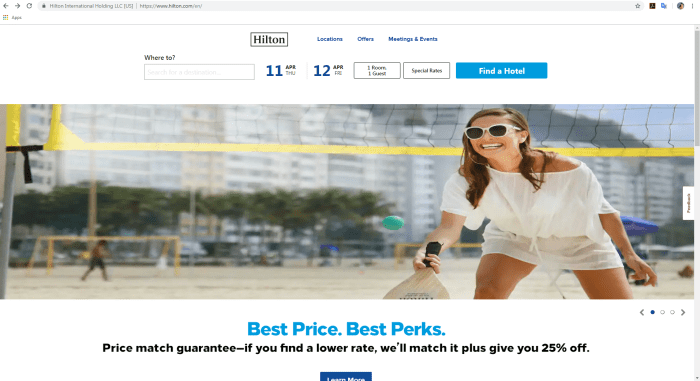
The Hilton booking site boasts impressive mobile responsiveness, ensuring a seamless booking experience across various devices, from large desktop screens to smaller smartphones. This adaptability is crucial for reaching a wide audience and providing convenience to users on the go. The site employs various techniques to achieve this responsiveness, adapting its layout and functionality to fit the screen size and orientation.
The site’s responsive design is evident in several key areas. For example, the main navigation menu adapts to different screen sizes, collapsing into a hamburger menu icon on smaller screens to conserve space. Similarly, images and text reflow seamlessly, adjusting their size and position to maintain optimal readability and visual appeal. The booking form itself is also responsive, with form fields adjusting dynamically to fit the available space, preventing awkward layouts or scrolling issues. This intelligent resizing ensures users can easily complete their booking regardless of the device they are using.
Ease of Mobile Booking
The mobile booking experience on the Hilton site is generally intuitive and user-friendly. Navigation is straightforward, and key information, such as dates, room types, and prices, is clearly displayed. The responsive design elements mentioned previously contribute to this ease of use. Users can easily search for hotels, browse available rooms, view photos, and complete the booking process without encountering significant difficulties. The mobile site is designed to prioritize essential information, reducing clutter and making the booking process as efficient as possible. Features such as saved payment information and guest profiles also contribute to a streamlined experience.
Key Differences Between Desktop and Mobile Versions
While the core functionality remains consistent across desktop and mobile versions, some key differences exist. The desktop version offers a more expansive view of information, allowing users to see more details at a glance. For example, the desktop version might display more hotel amenities or room photos simultaneously. The mobile version prioritizes a more streamlined and efficient experience, focusing on the essential steps in the booking process. Interactive elements, such as the map view, may also be simplified on mobile to enhance usability on smaller screens. Essentially, the desktop version provides a richer, more detailed experience, while the mobile version emphasizes speed and efficiency.
Comparative Analysis of Mobile Booking Experiences
The following table compares the mobile booking experience on the Hilton site with that of Marriott (a major competitor).
| Feature | Hilton | Marriott | Observation |
|---|---|---|---|
| Navigation | Intuitive, easy-to-use hamburger menu | Similar intuitive navigation, but potentially slightly more cluttered | Both sites offer easy navigation, but Hilton’s is arguably more streamlined on mobile. |
| Search Functionality | Quick and responsive search with various filter options | Comparable search functionality, with similar filter options | Both sites provide efficient search tools; the user experience is very similar. |
| Booking Process | Streamlined, straightforward process with clear instructions | Similar streamlined process, but potentially slightly more steps involved. | Hilton’s booking process appears slightly more efficient and less prone to user error. |
| Visual Appeal | Clean, modern design; high-quality images | Modern design, but images might not be as consistently high-quality. | Hilton’s visual appeal is slightly stronger due to consistently high-quality images and cleaner design. |
Hilton Booking Site Content and Messaging

Source: ncesc.com
The Hilton booking site’s content aims for a balance of sophistication and approachability. It needs to convey luxury and comfort while remaining easy to navigate and understand for a broad audience. The overall tone is confident, positive, and reassuring, focusing on the ease and enjoyment of the booking process and the experience of staying at a Hilton hotel.
The website communicates Hilton’s value proposition through highlighting the various benefits of choosing their hotels. This includes showcasing the range of hotel brands (from budget-friendly Hampton Inns to luxury Conrad hotels), emphasizing the consistency of quality and service across all brands, and promoting loyalty programs and exclusive offers to incentivize bookings. The value proposition is subtly woven throughout the site, rather than being explicitly stated in one place. It’s communicated through high-quality imagery, detailed descriptions of amenities, and testimonials from satisfied guests.
Persuasive Copywriting Examples
The Hilton website utilizes several persuasive copywriting techniques. For example, they frequently use strong action verbs to encourage bookings (“Book Now,” “Find Your Perfect Stay”). They also incorporate social proof, such as customer reviews and ratings, to build trust and credibility. Descriptive language paints a vivid picture of the hotel experience, appealing to the senses and creating a sense of desire. An example might be a description of a room featuring “plush bedding and breathtaking ocean views,” which goes beyond simply listing features. They also highlight unique selling points, such as “Hilton Honors benefits” or “free Wi-Fi,” to differentiate themselves from competitors. Finally, the use of limited-time offers and discounts creates a sense of urgency, encouraging immediate action.
Alternative Homepage Messaging, Go hilton booking site
The current Hilton homepage could benefit from a more impactful opening message. Instead of simply showing a carousel of images, consider a bolder approach. One alternative could be a large, high-quality image showcasing a diverse range of Hilton guests enjoying their stay, followed by a concise headline like “Your Next Adventure Starts Here.” This approach emphasizes the emotional connection with travel and positions Hilton as a facilitator of unforgettable experiences. Below the headline, a brief, impactful description could be added, such as: “Find your perfect escape with Hilton’s diverse collection of hotels, offering unparalleled comfort, exceptional service, and unforgettable moments.” This message is concise, benefit-driven, and invites the user to explore further. Another alternative would be to focus on a specific travel need or desire – for example, a family vacation, a romantic getaway, or a business trip. This would allow for more targeted messaging and potentially higher conversion rates. Instead of a general appeal, a focused message such as “Plan your dream family vacation with Hilton” or “Unwind and reconnect with our romantic getaway packages” could be used.
Accessibility of the Hilton Booking Site
Source: ddi-dev.com
Making the Hilton booking site accessible to everyone is crucial for inclusivity and a positive user experience. This involves ensuring users with disabilities, such as visual, auditory, motor, or cognitive impairments, can easily navigate and book their stays. This section will examine the current accessibility features, adherence to WCAG guidelines, and areas for improvement.
The Hilton booking site incorporates several accessibility features designed to comply with the Web Content Accessibility Guidelines (WCAG). These features aim to make the site usable for people with a wide range of disabilities. However, the level of adherence to WCAG varies and continuous improvement is always needed.
WCAG Adherence
The Hilton booking site strives for WCAG compliance, focusing primarily on WCAG 2.1 Level AA. This means that the site aims to meet a high standard of accessibility, but complete compliance is a complex and ongoing process. Specific features, such as keyboard navigation, screen reader compatibility, and sufficient color contrast, are implemented to support users with various disabilities. Regular audits and updates are needed to address any shortcomings and maintain compliance with evolving accessibility standards. For instance, alt text for images ensures screen readers can describe visual content, and keyboard navigation allows users to interact with the site without a mouse.
Areas for Improvement
While Hilton makes efforts towards accessibility, continuous improvement is essential. The following suggestions aim to enhance the user experience for individuals with disabilities:
- Improved Keyboard Navigation: While keyboard navigation is available, some areas could benefit from more intuitive tab order and clear focus indicators to improve ease of use for keyboard-only users.
- Enhanced Screen Reader Compatibility: Further testing with various screen readers and assistive technologies is necessary to ensure all interactive elements and content are properly announced and understood. This includes providing detailed and descriptive labels for form fields and interactive elements.
- Increased Color Contrast: While some areas show good contrast, ensuring sufficient contrast ratios across the entire site, especially between text and background colors, is vital for users with low vision.
- Improved ARIA Attributes: Consistent and accurate use of ARIA attributes (Accessible Rich Internet Applications) can significantly improve the accessibility of dynamic content and complex interactive elements. This requires careful implementation and thorough testing.
- Alternative Input Methods: Explore supporting alternative input methods beyond keyboard and mouse, such as voice control or switch access, for users with significant motor impairments. This could involve integrating with existing assistive technology APIs.
Impact of Accessibility Features on User Experience
Implementing robust accessibility features significantly improves the overall user experience for all users, not just those with disabilities. Features like clear and concise language, logical navigation, and sufficient color contrast benefit everyone by enhancing clarity and ease of use. For example, alt text for images improves understanding for all users, while clear labeling of form fields helps everyone complete bookings efficiently. A more accessible site is simply a better site for everyone.
Ending Remarks
Source: cambon.id
Ultimately, the Hilton booking site offers a functional platform for hotel reservations, but there’s always room for improvement. By addressing the usability issues, enhancing mobile responsiveness, and further refining accessibility features, Hilton can elevate the user experience and increase customer satisfaction. Our analysis highlights key areas for optimization, emphasizing the importance of a seamless and intuitive booking process across all devices. A user-centered approach will ensure that Hilton maintains its competitive edge in the ever-evolving online travel market.